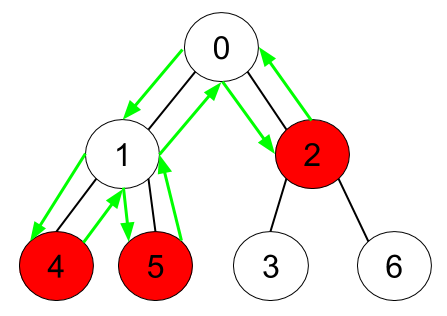
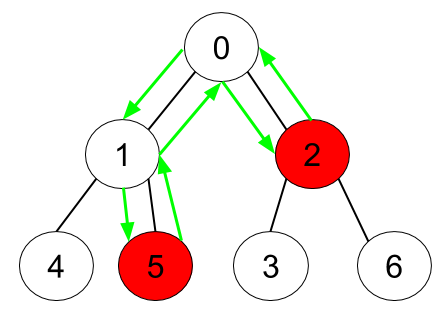
Given an undirected tree consisting of n vertices numbered from 0 to n-1, which has some apples in their vertices. You spend 1 second to walk over one edge of the tree. Return the minimum time in seconds you have to spend to collect all apples in the tree, starting at vertex 0 and coming back to this vertex.
The edges of the undirected tree are given in the array edges, where edges[i] = [ai, bi] means that exists an edge connecting the vertices ai and bi. Additionally, there is a boolean array hasApple, where hasApple[i] = true means that vertex i has an apple; otherwise, it does not have any apple.
Example 1:
Input: n = 7, edges = [[0,1],[0,2],[1,4],[1,5],[2,3],[2,6]], hasApple = [false,false,true,false,true,true,false]
Output: 8
Explanation: The figure above represents the given tree where red vertices have an apple. One optimal path to collect all apples is shown by the green arrows.
Example 2:
Input: n = 7, edges = [[0,1],[0,2],[1,4],[1,5],[2,3],[2,6]], hasApple = [false,false,true,false,false,true,false]
Output: 6
Explanation: The figure above represents the given tree where red vertices have an apple. One optimal path to collect all apples is shown by the green arrows.
We start at \(0\), collect every apple, and return, so each used edge is traversed twice. \(n\le 10^5\) allows one DFS.
A subtree with no apple and no further work can be skipped. Sum the children's costs (entering a child costs \(2\)), and add the incoming edge only if this node has an apple or a child contributed a positive cost. The root's incoming cost is \(0\).
We start at \(0\), collect every apple, and return, so each used edge is walked twice. With \(n \le 10^5\), recursing from the root to score every subtree is too deep: a chain makes the call depth \(n\).
A subtree with no apple and no further work can be skipped. After the children are done, add their round-trip costs; if this node has an apple or that sum is positive, add the cost of the incoming edge, which is \(0\) at the root and \(2\) elsewhere.
An explicit stack of \((node, parent, state)\) runs the postorder. On entry we push the exit marker and then the children, and on exit we store that cost. The root's cost is the answer.