Skip to content

113. Path Sum II

DifficultyMedium

Description

Given the root of a binary tree and an integer targetSum, return all root-to-leaf paths where the sum of the node values in the path equals targetSum. Each path should be returned as a list of the node values, not node references.

A root-to-leaf path is a path starting from the root and ending at any leaf node. A leaf is a node with no children.


Example 1:

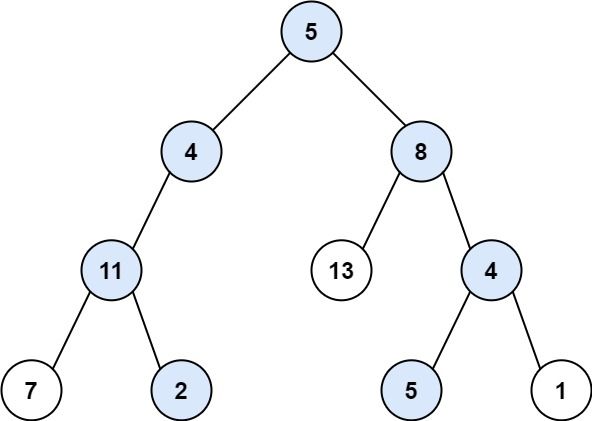
Input: root = [5,4,8,11,null,13,4,7,2,null,null,5,1], targetSum = 22
Output: [[5,4,11,2],[5,8,4,5]]
Explanation: There are two paths whose sum equals targetSum:
5 + 4 + 11 + 2 = 22
5 + 8 + 4 + 5 = 22

Example 2:

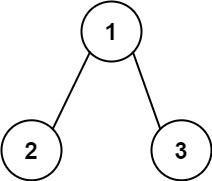
Input: root = [1,2,3], targetSum = 5
Output: []

Example 3:

Input: root = [1,2], targetSum = 0
Output: []


Constraints:

  • The number of nodes in the tree is in the range [0, 5000].
  • -1000 <= Node.val <= 1000
  • -1000 <= targetSum <= 1000

Solutions

Solution 1: DFS

Thinking

Unlike Path Sum, we must list every root-to-leaf path that sums to \(\textit{targetSum}\). \(n \le 5000\); copying every path into the answer can cost \(O(n^2)\).

DFS pushes the node onto a shared path and adds its value. At a matching leaf we copy the path; on the way back we pop, so both children reuse the same buffer.

We start from the root node, recursively traverse all paths from the root node to the leaf nodes, and record the path sum. When we traverse to a leaf node, if the current path sum equals targetSum, then we add this path to the answer.

The time complexity is \(O(n^2)\), where \(n\) is the number of nodes in the binary tree. The space complexity is \(O(n)\).

 1
 2
 3
 4
 5
 6
 7
 8
 9
10
11
12
13
14
15
16
17
18
19
20
21
22
23
# Definition for a binary tree node.
# class TreeNode:
#     def __init__(self, val=0, left=None, right=None):
#         self.val = val
#         self.left = left
#         self.right = right
class Solution:
    def pathSum(self, root: Optional[TreeNode], targetSum: int) -> List[List[int]]:
        def dfs(root, s):
            if root is None:
                return
            s += root.val
            t.append(root.val)
            if root.left is None and root.right is None and s == targetSum:
                ans.append(t[:])
            dfs(root.left, s)
            dfs(root.right, s)
            t.pop()

        ans = []
        t = []
        dfs(root, 0)
        return ans
 1
 2
 3
 4
 5
 6
 7
 8
 9
10
11
12
13
14
15
16
17
18
19
20
21
22
23
24
25
26
27
28
29
30
31
32
33
34
35
36
37
38
/**
 * Definition for a binary tree node.
 * public class TreeNode {
 *     int val;
 *     TreeNode left;
 *     TreeNode right;
 *     TreeNode() {}
 *     TreeNode(int val) { this.val = val; }
 *     TreeNode(int val, TreeNode left, TreeNode right) {
 *         this.val = val;
 *         this.left = left;
 *         this.right = right;
 *     }
 * }
 */
class Solution {
    private List<List<Integer>> ans = new ArrayList<>();
    private List<Integer> t = new ArrayList<>();

    public List<List<Integer>> pathSum(TreeNode root, int targetSum) {
        dfs(root, targetSum);
        return ans;
    }

    private void dfs(TreeNode root, int s) {
        if (root == null) {
            return;
        }
        s -= root.val;
        t.add(root.val);
        if (root.left == null && root.right == null && s == 0) {
            ans.add(new ArrayList<>(t));
        }
        dfs(root.left, s);
        dfs(root.right, s);
        t.remove(t.size() - 1);
    }
}
 1
 2
 3
 4
 5
 6
 7
 8
 9
10
11
12
13
14
15
16
17
18
19
20
21
22
23
24
25
26
27
28
29
/**
 * Definition for a binary tree node.
 * struct TreeNode {
 *     int val;
 *     TreeNode *left;
 *     TreeNode *right;
 *     TreeNode() : val(0), left(nullptr), right(nullptr) {}
 *     TreeNode(int x) : val(x), left(nullptr), right(nullptr) {}
 *     TreeNode(int x, TreeNode *left, TreeNode *right) : val(x), left(left), right(right) {}
 * };
 */
class Solution {
public:
    vector<vector<int>> pathSum(TreeNode* root, int targetSum) {
        vector<vector<int>> ans;
        vector<int> t;
        function<void(TreeNode*, int)> dfs = [&](TreeNode* root, int s) {
            if (!root) return;
            s -= root->val;
            t.emplace_back(root->val);
            if (!root->left && !root->right && s == 0) ans.emplace_back(t);
            dfs(root->left, s);
            dfs(root->right, s);
            t.pop_back();
        };
        dfs(root, targetSum);
        return ans;
    }
};
 1
 2
 3
 4
 5
 6
 7
 8
 9
10
11
12
13
14
15
16
17
18
19
20
21
22
23
24
25
26
27
/**
 * Definition for a binary tree node.
 * type TreeNode struct {
 *     Val int
 *     Left *TreeNode
 *     Right *TreeNode
 * }
 */
func pathSum(root *TreeNode, targetSum int) (ans [][]int) {
    t := []int{}
    var dfs func(*TreeNode, int)
    dfs = func(root *TreeNode, s int) {
        if root == nil {
            return
        }
        s -= root.Val
        t = append(t, root.Val)
        if root.Left == nil && root.Right == nil && s == 0 {
            ans = append(ans, slices.Clone(t))
        }
        dfs(root.Left, s)
        dfs(root.Right, s)
        t = t[:len(t)-1]
    }
    dfs(root, targetSum)
    return
}
 1
 2
 3
 4
 5
 6
 7
 8
 9
10
11
12
13
14
15
16
17
18
19
20
21
22
23
24
25
26
27
28
29
30
31
32
33
34
35
36
37
38
39
40
41
42
43
44
45
46
47
48
49
50
51
52
53
54
// Definition for a binary tree node.
// #[derive(Debug, PartialEq, Eq)]
// pub struct TreeNode {
//   pub val: i32,
//   pub left: Option<Rc<RefCell<TreeNode>>>,
//   pub right: Option<Rc<RefCell<TreeNode>>>,
// }
//
// impl TreeNode {
//   #[inline]
//   pub fn new(val: i32) -> Self {
//     TreeNode {
//       val,
//       left: None,
//       right: None
//     }
//   }
// }
use std::cell::RefCell;
use std::rc::Rc;
impl Solution {
    fn dfs(
        root: Option<Rc<RefCell<TreeNode>>>,
        paths: &mut Vec<i32>,
        mut target_sum: i32,
        res: &mut Vec<Vec<i32>>,
    ) {
        if let Some(node) = root {
            let mut node = node.borrow_mut();
            target_sum -= node.val;
            paths.push(node.val);
            if node.left.is_none() && node.right.is_none() {
                if target_sum == 0 {
                    res.push(paths.clone());
                }
            } else {
                if node.left.is_some() {
                    Self::dfs(node.left.take(), paths, target_sum, res);
                }
                if node.right.is_some() {
                    Self::dfs(node.right.take(), paths, target_sum, res);
                }
            }
            paths.pop();
        }
    }

    pub fn path_sum(root: Option<Rc<RefCell<TreeNode>>>, target_sum: i32) -> Vec<Vec<i32>> {
        let mut res = vec![];
        let mut paths = vec![];
        Self::dfs(root, &mut paths, target_sum, &mut res);
        res
    }
}
 1
 2
 3
 4
 5
 6
 7
 8
 9
10
11
12
13
14
15
16
17
18
19
20
21
22
23
24
25
26
27
28
/**
 * Definition for a binary tree node.
 * function TreeNode(val, left, right) {
 *     this.val = (val===undefined ? 0 : val)
 *     this.left = (left===undefined ? null : left)
 *     this.right = (right===undefined ? null : right)
 * }
 */
/**
 * @param {TreeNode} root
 * @param {number} targetSum
 * @return {number[][]}
 */
var pathSum = function (root, targetSum) {
    const ans = [];
    const t = [];
    function dfs(root, s) {
        if (!root) return;
        s -= root.val;
        t.push(root.val);
        if (!root.left && !root.right && s == 0) ans.push([...t]);
        dfs(root.left, s);
        dfs(root.right, s);
        t.pop();
    }
    dfs(root, targetSum);
    return ans;
};

Comments